
Most people in clinical development still call the protocol the “source of truth.” Technically, that’s correct. In practice, it’s usually just a long Word document or a locked PDF that every team has to interpret all over again.
That quiet inefficiency is something almost every study team has felt.
The Real Problem With Static Protocols
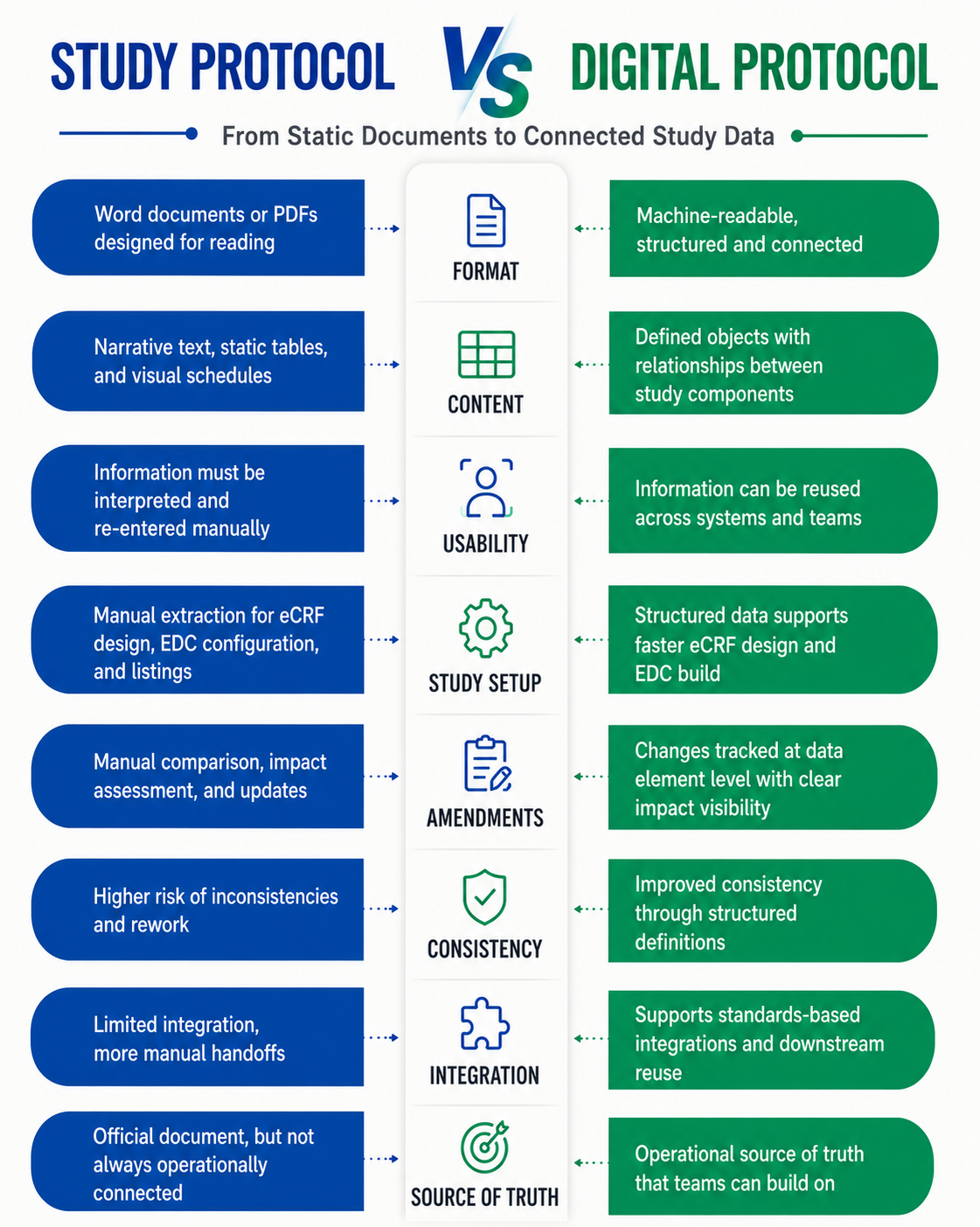
A traditional protocol contains everything & objectives, endpoints, eligibility criteria, treatment arms, visit schedules, assessments, safety rules, and statistical considerations. Yet almost none of that information can be used directly by systems.
What happens next is familiar if you’ve ever been involved in study start-up. Data managers and clinical programmers sit with the protocol and start translating it by hand. They pull out the schedule of assessments, design the eCRFs, and configure the EDC system. When an amendment comes in, much of that work gets repeated.
The process is slow. It’s expensive. And it quietly introduces small inconsistencies that later show up as queries, deviations, or rework. The protocol remains the official document, but it is not an operational data asset.
What Actually Makes a Protocol "Digital"?
A Digital Protocol is not a PDF sitting in a document management system. It is also not just a Word file that an AI has summarized.
It is a structured, machine-readable version of the study design. Core elements are captured as connected data objects & study identifiers, arms, epochs, visits, activities, procedures, endpoints, eligibility criteria, and assessment requirements.
When these pieces exist as structured data instead of narrative text and visual tables, the protocol can finally be reused rather than re-interpreted. That difference matters more than most people realize.
Turning Narrative Into Structured Study Data
In a normal protocol, the Schedule of Assessments is a table that people have to read carefully and interpret. In a Digital Protocol, the same information exists as defined relationships between visits, activities, and data elements.
This becomes the foundation. Once the study design is structured, downstream teams no longer start from a blank page or from a static table. They start from data that already describes what the study is supposed to do.
Where LLMs Actually Help
Large language models can be useful here, but only if we stay honest about their role.
When a team provides basic design inputs — indication, phase, primary endpoint, arms, and a high-level visit structure — an LLM can help draft sections, prefill content, suggest more consistent language, and support the creation of a schedule of assessments. It can also surface internal inconsistencies that are easy to miss when a document gets long.
These are real productivity gains. They reduce repetitive writing and help teams reach a first complete draft faster. What they do not do is replace clinical judgment, statistical thinking, or regulatory responsibility.
Human Review Is Not Optional
Even when content is generated or structured with the help of an LLM, the final review still belongs to people. Medical writers, clinicians, statisticians, and regulatory experts still need to examine the protocol for scientific accuracy, safety, and operational feasibility.
This point is worth repeating, because it is easy to overlook in the current wave of AI enthusiasm. Technology can improve speed and consistency. It cannot take accountability for the protocol.
From Digital Protocol to Study Setup
Once the protocol exists as structured data, a meaningful part of the traditional study-build burden can be reduced. Visit schedules, assessment lists, and data collection requirements can support eCRF design and EDC configuration more directly.
In environments that support standards such as USDM or CDISC ODM, and where integrations exist, structured protocol information can flow into downstream systems with less manual re-entry. This does not mean a complete EDC study appears automatically at the click of a button. Different platforms have different capabilities. What it does mean is that teams spend less time re-typing information that already exists and more time on validation and exception handling.
Protocol Amendments: Where the Value Becomes Obvious
Amendments are where the limitations of static protocols become painful. Teams have to compare documents, hunt for affected visits and forms, update the EDC, and check related materials — mostly by hand.
With a Digital Protocol, changes can be identified at the level of structured elements. Dependencies can be assessed more systematically, and the components that may need updating can be flagged for review. This does not remove the need for careful human evaluation, but it replaces a large amount of manual searching with a more targeted process.
Anyone who has lived through multiple mid-study amendments will understand why this matters.
A Single Source of Truth That Is Actually Usable
The most important long-term opportunity is the ability to maintain a structured source of truth that downstream teams can reuse instead of recreating.
In a better setup, the same structured study definition can support the path from protocol to study definition, EDC configuration, data standards, and analytics. When teams work from shared structured information rather than repeatedly interpreting a document, consistency improves and unnecessary rework declines.
What Can Be Improved and What Cannot
Digital Protocols and LLMs can reduce manual transcription, improve consistency, and accelerate parts of study setup. They cannot take final regulatory responsibility, make medical decisions, or produce error-free content without expert oversight.
The real opportunity is not to remove people from the process. It is to give skilled teams better tools so they can focus on the decisions that actually require judgment.
Closing Thought
The industry has treated the protocol as a document for a very long time. The next step is to treat it as connected study data.
Moving from static documents to structured Digital Protocols will not solve every operational problem in clinical trials. But it can remove one of the most persistent sources of friction between study design and study execution. That alone is worth taking seriously.